⚖
Equal
No citizen is constitutionally superior to another. Equal civic dignity is the starting point.
A shared civic identity
A Supreme Citizen is not a person who stands above other citizens or outside the law. It is an individual expression of membership in the sovereign civic body—We the People—and of the responsibilities that self-government requires.
Where this page fits: About the Initiative → The Charter → 12 Principles → Supreme Citizen → Citizens Branch → Citizen Action Guide
No citizen is constitutionally superior to another. Equal civic dignity is the starting point.
Civic authority is exercised through constitutional institutions, lawful processes, rights, and limits.
Rights are joined to duties of participation, judgment, accountability, peaceful disagreement, and stewardship.
Collective popular sovereignty
The phrase describes the people collectively as the ultimate source of legitimate political authority. Government receives delegated constitutional authority; it does not create the people’s sovereignty as a political favor.
The plural form matters because sovereignty is collective. The identity is intentionally inclusive: citizens can disagree sharply about policy, ideology, candidates, and parties while remaining equal participants in the same constitutional order.
Individual civic identity
The singular form turns the collective constitutional principle into a personal civic ethic. A Supreme Citizen is informed without being unquestioning, patriotic without surrendering independent judgment, skeptical of concentrated power while respecting lawful institutions, and protective of liberty for both self and others.
It is a statement of membership and responsibility—not rank, privilege, legal immunity, or exemption.
Works within constitutional government.
Accepts the rule of law.
Uses elections, courts, petitions, peaceful protest, legislation, and public participation.
Claims civic responsibility.
Defends constitutional rights within the legal system.
Does not claim personal exemption from government.
Does not claim courts or ordinary laws cease to apply by personal declaration.
Does not reject lawful civic obligations.
Does not assert special personal immunity or superior legal status.
An Important Distinction
The names may sound similar, but the ideas are fundamentally different. The Supreme Citizens Charter is grounded in constitutional citizenship, equal civic dignity, the rule of law, and peaceful participation within the American constitutional system.
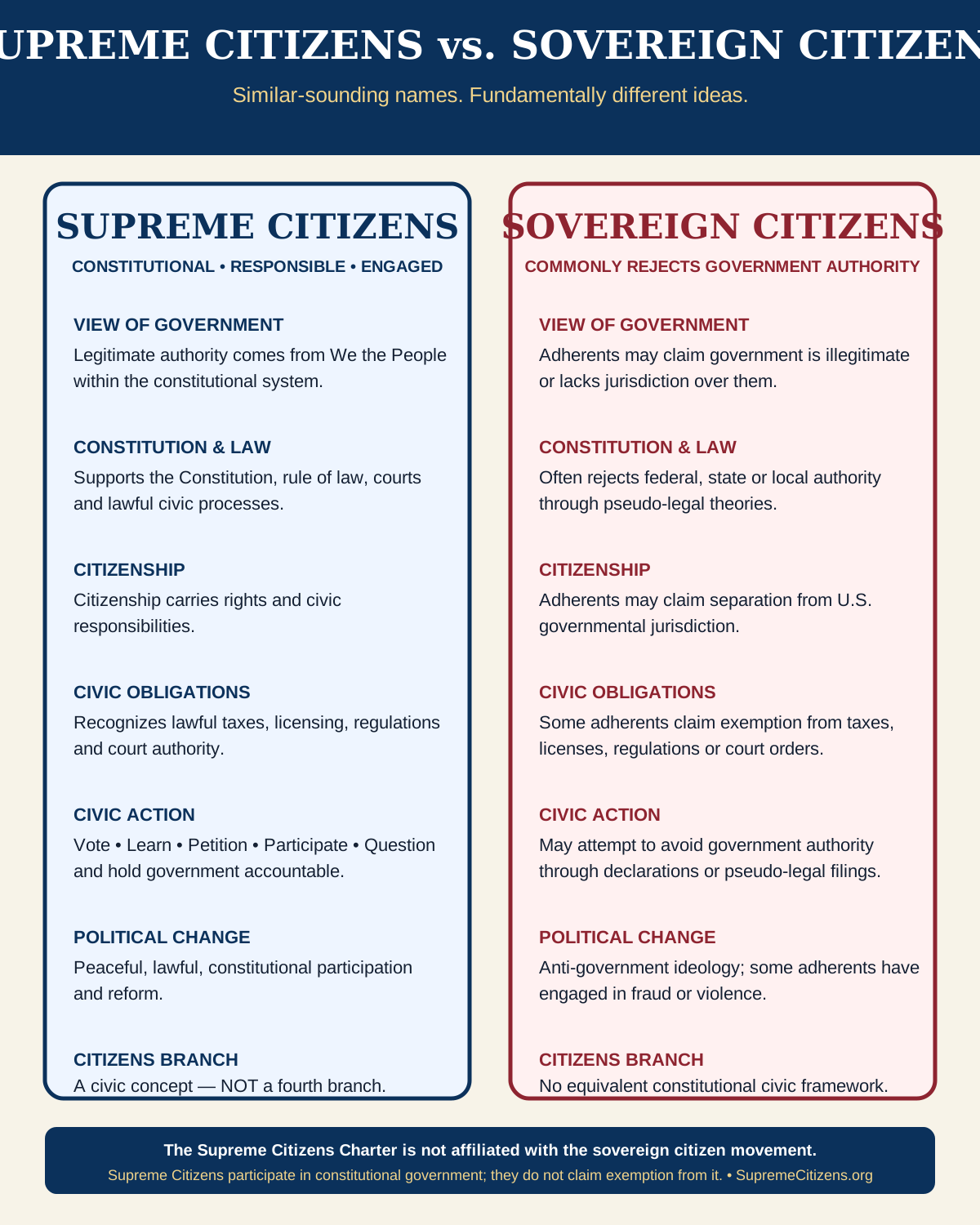
Because the terms “Supreme Citizens” and “sovereign citizens” can sound similar, readers may mistakenly assume that they describe related ideas. They do not. The Supreme Citizens Charter uses popular sovereignty in its constitutional sense: political authority originates with We the People and is exercised through the Constitution, representative government, lawful institutions, elections, courts, and civic participation. It does not treat individual citizens as personally sovereign over the law or exempt from governmental jurisdiction.
Supreme Citizens recognizes that “We the People” are the source of legitimate political authority within the constitutional system—not outside it. Citizens and public officials alike remain subject to the Constitution and the rule of law.
The Citizens Branch is a civic concept for informed participation and accountability. It is not a fourth branch of government and does not claim immunity from laws, taxes, courts, licensing requirements, regulations, or other lawful civic obligations.
The Supreme Citizens Charter is not affiliated with the sovereign citizen movement.
Frequently Asked Questions
Clear answers to common questions about the Charter, the Supreme Citizen civic identity, and the Citizens Branch concept.
No. The Supreme Citizens Charter is a civic and educational initiative, not a political party. It does not endorse candidates or instruct citizens which party to support. Its purpose is to encourage constitutional literacy, informed participation, civic responsibility, accountability, and respect for the rights of others.
No. The term describes citizens as participants in the collective constitutional sovereignty of “We the People.” It does not give any individual superior legal status, immunity, or exemption. Citizens and public officials remain subject to the Constitution and applicable law.
No. The Citizens Branch is a civic concept, not a governmental institution and not a proposed constitutional branch. It describes the continuing role of citizens in learning, voting, petitioning, communicating with representatives, evaluating information, questioning power, serving their communities, and holding public officials accountable through lawful means.
No. The Supreme Citizens Charter is not affiliated with the sovereign citizen movement. It recognizes constitutional government, courts, elections, lawful civic obligations, and the rule of law. It does not claim that individuals can exempt themselves from governmental jurisdiction through personal declarations or pseudo-legal theories.
No. Popular sovereignty means that legitimate governmental authority ultimately originates with the people and is structured through the Constitution. In a constitutional republic, that principle operates through constitutional institutions and lawful democratic processes; it does not place individuals outside the legal system.
No. The Charter is an educational and civic framework. It does not replace, amend, supersede, or carry the legal authority of the U.S. Constitution, federal or state law, or judicial decisions.
No. The project is designed around shared constitutional citizenship rather than partisan identity. Citizens can disagree about policies, candidates, political parties, and interpretations of public issues while participating peacefully and respecting the constitutional rights of others.
Participation begins with learning how government works and exercising the lawful tools of citizenship: voting, contacting representatives, petitioning government, attending public meetings, evaluating public information, serving your community, defending constitutional rights, and holding public officials accountable. The Citizen Action Guide provides additional ways to become involved.
Explore practical ways to learn, participate, communicate with government, and serve your community.
Explore the Citizen Action Guide